Hotline: 0937 970 889 Email: vanlapnv@gmail.com Bình Minh - Bình Châu - Tp. Hồ Chí Minh

Plasma Water Treatment Technology

Plasma Water Treatment Technology

Plasma Water Treatment Technology: A Groundbreaking Green Solution for 2026

This is where plasma water treatment technology takes the lead—a revolution in water purification using pure physical power without a single drop of toxic chemicals. Are you concerned that even after RO filtration, residues of antibiotics or “forever chemicals” like PFAS still silently persist? Traditional methods such as Chlorine or UV radiation are increasingly revealing limitations regarding efficiency and long-term safety.

What is Plasma Water Treatment Technology and How Does It Work?

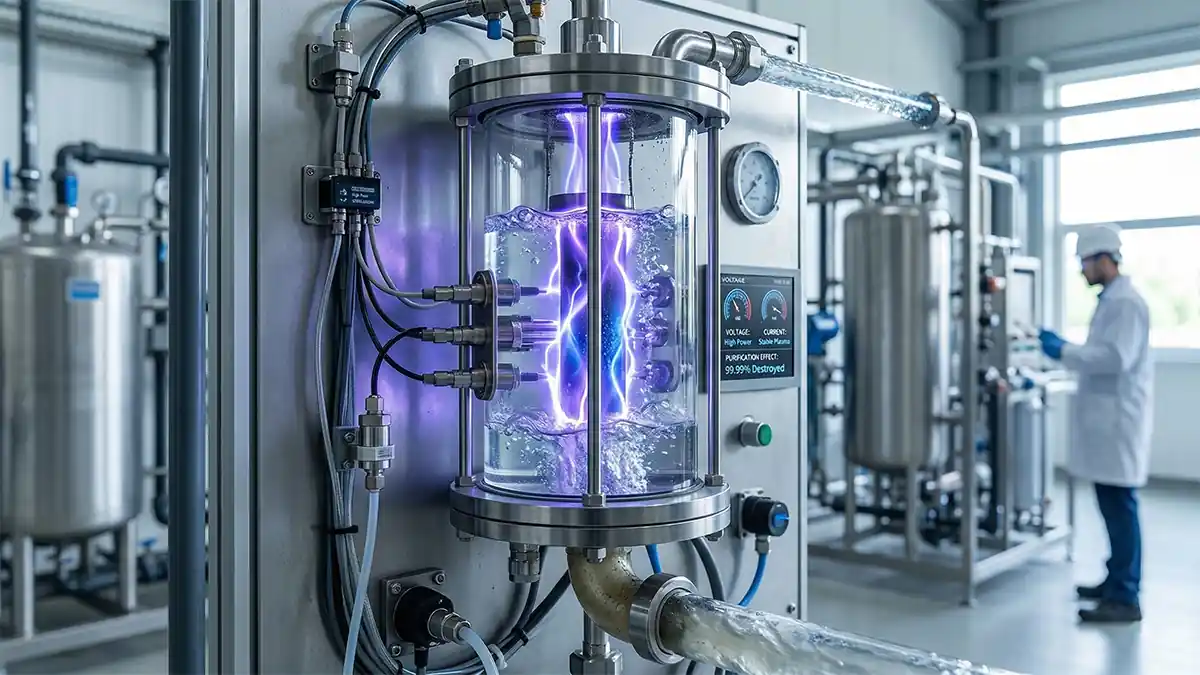
In essence, plasma water treatment technology utilizes the fourth state of matter. When high-voltage electrical energy is applied to water or the air in contact with water, gas molecules become ionized, creating Cold Plasma.

The Nature of Cold Plasma in Aqueous Environments

This plasma stream contains billions of highly reactive free radicals, such as hydroxyl (.OH), Ozone (O3), and H2O2. These act as microscopic “warriors,” directly attacking the cellular structures of bacteria and breaking the chemical bonds of pollutants. Unlike mechanical filtration, plasma water treatment technology performs a chemical decomposition process right within the liquid, converting toxins into harmless water and CO2
Plasma Water Treatment Technology

Why is Plasma Water Treatment Technology Superior to UV and Ozone?

Many often compare Plasma to UV. However, UV can only inactivate bacteria if the water is sufficiently clear. In contrast, plasma water treatment technology is not heavily dependent on water turbidity, thanks to the Advanced Oxidation Process (AOP).

Superior Ability to Eradicate Bacteria and Ultrafine Viruses

Plasma does not just destroy DNA; it completely ruptures the protein envelope of viruses. The free radicals in Plasma have reaction speeds thousands of times faster than conventional disinfectants, helping to eliminate drug-resistant superbugs that UV light sometimes misses.

Efficient Decomposition of Hard-to-Treat Organic Compounds

This is the “highlight” of this technology. Plasma water treatment technology is capable of breaking down complex carbon chains in pesticides, industrial dyes, and hormone residues. This process does not create toxic by-products (like Trihalomethanes when using Chlorine), ensuring a sustainable and eco-friendly water source.

Image Suggestion: A chart comparing the organic treatment speed between Plasma technology and traditional Ozone methods.

How Long Does the Plasma Water Treatment Process Take?

Speed is a major advantage. Depending on the pollution concentration, the plasma water treatment technology process usually takes only a few seconds to a few minutes to achieve a disinfection efficiency of up to 99.9%. For industrial scales, continuous water flow through Plasma electrode modules is cleaned instantly, ensuring continuous operational performance without the need for settling time or slow chemical reactions.

Real-World Applications of Plasma Water Treatment Systems in Life and Production

Currently, plasma water treatment technology equipment is being strongly applied in clean food production lines and medical wastewater treatment. This technology helps fully automate the disinfection process, ensuring the output water meets pure standards without altering the natural taste of the product. This is particularly important in industries requiring strict food safety standards (HACCP, ISO 22000).

Common Misconceptions About the Safety of Plasma-Treated Water

Some worry that high voltage might alter the physical and chemical properties of the water. In fact, scientific studies have proven that plasma water treatment technology only acts for an extremely short duration. Immediately after the current is cut, free radicals spontaneously recombine into stable water molecules. Treated water is completely benign and even richer in dissolved oxygen, which is beneficial for human health and the growth of aquatic organisms.

Are Installation and Operating Costs of Plasma Systems Expensive?

Although the initial investment for plasma water treatment technology systems may be higher than crude filters, the operating costs are highly optimized. The system does not require the purchase, storage, or transport of toxic chemicals. The electricity consumption of modern Plasma machines has been optimized through inverter technology, equivalent only to the consumption of an industrial lighting system.

FAQ – Answering Questions About Plasma Water Treatment Systems

  • Can plasma-treated water be consumed directly?Absolutely. If the system integrates an additional bacterial debris filter, the output water will meet direct drinking standards with high purity.
  • Does Plasma technology remove heavy metals?The primary mechanism of plasma water treatment technology is disinfection and organic decomposition. To remove heavy metals, the system is usually combined with precipitation or ion exchange processes.
  • Is the equipment easy to install in old systems?Plasma modules are designed as “Plug & Play” units, making them very easy to integrate into existing pipelines without requiring significant infrastructure changes.

Conclusion:

Choosing plasma water treatment technology is not just an investment in water quality but a commitment to a sustainable green future. If you are looking for a thorough, safe, and highly automated solution, this is the perfect answer for 2026 technology trends.

Key Design Parameters for Plasma Water Treatment Technology

Plasma water treatment technology cannot be selected from voltage or generator power alone. A practical design starts with the target contaminant, influent concentration, flow rate, conductivity, pH, temperature, turbidity, and required treated-water quality. These factors influence how electrical energy is transferred into the gas-liquid interface and how reactive species interact with compounds in the water.

Reactor geometry is equally important. Direct discharge in water, discharge above the surface, plasma jets, dielectric barrier discharge, and bubble-assisted reactors create different contact conditions. Engineers should document the electrode arrangement, gas type, gas flow, power waveform, frequency, treatment volume, hydraulic residence time, and energy input. Without these parameters, results from different plasma systems cannot be compared reliably.

Cold plasma discharge used in plasma water treatment technology
A cold plasma discharge creates reactive species near the gas-liquid interface.

Reactive Species and Treatment Mechanisms

The liquid chemistry created by plasma water treatment technology may include short-lived radicals and longer-lived reactive oxygen and nitrogen species. Their formation depends on the working gas, humidity, water composition, electrical conditions, and contact time. These species can contribute to oxidation, reduction, disinfection, changes in pH, and transformation of dissolved compounds.

A peer-reviewed review indexed by PubMed on plasma-activated water describes how reactive oxygen and nitrogen species contribute to the properties of plasma-activated water. The review also emphasizes treatment conditions and applications rather than treating all plasma reactors as equivalent. This distinction matters when moving from a laboratory sample to a continuous industrial flow.

How to Plan a Pilot Test

A pilot should use representative water collected across normal production conditions. Before running plasma water treatment technology, the team should establish baseline values for the selected parameters. Depending on the application, these may include COD, color, odor, turbidity, microbial indicators, specific organic compounds, iron, manganese, ammonia, or other project-specific targets.

The test plan should define sampling points, treatment duration, flow rate, energy consumption, and analytical methods. Samples need suitable containers, preservation, and holding times. A control sample helps distinguish plasma effects from aeration, settling, temperature, or natural decay. Repeated tests are more useful than one favorable result because industrial water quality rarely remains constant throughout a day.

Successful pilot results should be expressed as both treatment performance and resource demand. Removal percentage alone can be misleading when the influent concentration changes. Reporting mass removed, volume treated, electrical energy, gas consumption, electrode condition, and maintenance requirements gives decision-makers a clearer basis for scale-up.

Integration with Existing Water Treatment Processes

Plasma water treatment technology is often most effective as one stage in a treatment train. Screening, sedimentation, filtration, biological treatment, activated carbon, membranes, or ion exchange may remove bulk contaminants before plasma polishing. Pretreatment can reduce radical scavenging and allow the plasma reactor to focus on compounds that are difficult to address through conventional steps.

The correct sequence depends on the objective. For water with high suspended solids, separation should normally occur before a plasma reactor. For biodegradable wastewater, biological treatment may remove the main organic load at lower energy demand, while plasma is evaluated for color, odor, disinfection, or persistent residual compounds. Post-treatment may be needed to remove reaction products or stabilize water quality.

The US EPA overview of advanced oxidation notes that oxidation performance depends on dose, contact time, contaminant concentration, and water-quality factors such as radical scavengers. Although plasma is a different reactor platform, the same engineering discipline is useful: characterize the matrix, define the target, and verify by measurement.

Reactive discharge and ultraviolet emission in plasma water treatment technology
Plasma-liquid systems must be evaluated through measurable reactor and water-quality parameters.

Safety and Materials Compatibility

High voltage requires interlocks, grounding, insulated enclosures, emergency shutdown, and access control. A plasma water treatment technology installation should also consider ozone or other gases that may be produced around the reactor. Ventilation and off-gas management must match the reactor design and local workplace requirements.

Electrodes, seals, pipes, and reactor walls must be compatible with water chemistry and operating conditions. Corrosion can change treatment performance and introduce unwanted material into the water. Inspection intervals should be based on hours of operation, electrode wear, scale formation, fouling, temperature, and changes in power demand.

Operating Cost and Energy Evaluation

The cost of plasma water treatment technology includes more than electricity. A complete estimate covers power electronics, gas supply where required, pumping, cooling, electrode replacement, cleaning, analytical testing, labor, and downtime. Energy should be reported per unit of treated volume and, where possible, per unit of contaminant removed.

Operating at the highest power is not always the most efficient choice. Once reactive species are consumed by non-target compounds, additional energy may produce diminishing returns. Pilot data can identify the practical operating window and show whether pretreatment, recirculation, staged reactors, or a different contact method improves efficiency.

Commissioning Checklist

  • Confirm influent flow, water-quality range, and treatment objectives.
  • Record reactor geometry, electrical settings, gas conditions, and contact time.
  • Verify grounding, interlocks, ventilation, and emergency shutdown.
  • Use consistent sampling points and validated analytical methods.
  • Compare performance at normal, minimum, and peak hydraulic loads.
  • Track energy, electrode condition, fouling, and maintenance time.
  • Document by-products and determine whether post-treatment is required.
  • Train operators to recognize abnormal sound, temperature, odor, and power behavior.

When Is Plasma Water Treatment Technology a Good Fit?

Plasma water treatment technology deserves pilot evaluation when a project has a defined contaminant or disinfection target, conventional processes leave a difficult residual, and the operator can monitor performance. It is less suitable when the influent is poorly characterized, solids are uncontrolled, or the project expects one reactor to replace every treatment stage.

IES VNTECH can review water-quality data, flow, existing equipment, and the required outlet target before proposing a test. See our Vietnamese overview of plasma water treatment or contact the technical team to discuss sampling, pilot configuration, and acceptance criteria.

Scale-Up from Batch Tests to Continuous Operation

A successful beaker test does not automatically prove that plasma water treatment technology will perform at industrial flow. Scale-up changes the surface-area-to-volume ratio, mixing pattern, gas transfer, electrode spacing, heat removal, and residence-time distribution. Engineers should identify which laboratory variables control performance and preserve those relationships as closely as possible in the pilot reactor.

Continuous systems also experience fluctuations that are absent from a prepared batch. The influent may change with production schedules, cleaning cycles, rainfall, or upstream treatment. A scale-up plan should therefore define the operating envelope rather than one ideal condition. Minimum, average, and peak values for flow and contaminant concentration are needed to size the reactor, recirculation loop, buffer tank, and supporting equipment.

Modular scale-up can reduce risk. Instead of building one large reactor immediately, the project can test parallel modules and determine how performance changes as flow is divided. This approach makes maintenance easier and provides partial capacity when one module is offline. However, the hydraulic distribution between modules must be measured and balanced.

Performance Monitoring and Acceptance Criteria

Acceptance criteria for plasma water treatment technology must be written before commissioning. Each target needs a sampling location, analytical method, frequency, and pass condition. If the objective is disinfection, the project should identify the indicator organism and required reduction. If the objective is oxidation, it should define the compound, color, COD fraction, odor, or other measurable endpoint.

Online instruments can support operation but do not replace laboratory analysis. Flow, pH, conductivity, oxidation-reduction potential, temperature, dissolved oxygen, power, and pressure may reveal process changes quickly. Instrument readings should be checked against samples so operators know which trends are meaningful. Sensors also need cleaning and calibration schedules because fouling can create false confidence.

Data should be evaluated as a time series. A single passing sample cannot demonstrate stable treatment during a variable production week. Useful reports show influent and effluent results together with flow, energy, reactor settings, maintenance events, and abnormal conditions. This makes it possible to distinguish a water-quality change from a reactor problem.

Maintenance Plan for Plasma Reactors

The maintenance plan for plasma water treatment technology should cover electrodes, dielectric materials, seals, gas lines, pumps, cooling, power electronics, ventilation, and instrumentation. Inspection frequency is initially based on supplier guidance and pilot experience, then refined using operating data. Electrode erosion, deposits, discoloration, cracking, leakage, unstable discharge, or rising energy demand should trigger investigation.

Water hardness, suspended solids, iron, manganese, and organic material may cause scale or fouling. Cleaning methods must be compatible with reactor materials and must not leave residues that interfere with the next treatment cycle. Operators should record cleaning chemistry, concentration, contact time, rinse volume, and the observed condition before and after service.

Critical spare parts should be identified during design. Long delivery times for a power component or custom electrode can create extended downtime. A practical spare-parts list includes expected service life, storage conditions, replacement instructions, and the tests required before returning a module to operation.

Frequently Asked Engineering Questions

Can plasma replace biological treatment?

Not in every application. Biological processes are often efficient for large biodegradable loads, while plasma water treatment technology may be evaluated for disinfection, polishing, color, odor, or persistent compounds. A treatment train should assign each stage to the task it can perform efficiently. Pilot testing is necessary before removing an existing biological step.

Does plasma treatment create by-products?

Oxidation transforms compounds, so reaction products must be considered. Their identity depends on the original water matrix and operating conditions. Projects should not assume that disappearance of the parent compound proves complete mineralization. Analytical work may be needed to check intermediates, toxicity, residual oxidants, nitrate, nitrite, or other relevant parameters.

How is energy efficiency improved?

Efficiency can improve through pretreatment, better gas-liquid contact, optimized pulse conditions, staged operation, recirculation, or stopping at the treatment endpoint instead of applying excess energy. The best option depends on the reactor. Comparing energy per cubic meter and energy per mass of contaminant removed helps prevent misleading conclusions.

What information is needed for a technical proposal?

A useful proposal requires flow data, water analyses, target outlet quality, operating hours, available space, utilities, existing treatment steps, and site safety constraints. For plasma water treatment technology, representative samples are especially valuable because conductivity, turbidity, organics, and radical scavengers can change reactor performance. A proposal should state its assumptions and define how they will be verified.

Decision Framework

Before investment, compare the plasma option with a technically credible baseline. The comparison should include treatment performance, footprint, energy, chemicals, residuals, maintenance, operator skill, monitoring, and lifecycle cost. Laboratory novelty alone is not a sufficient decision criterion. The selected process must remain controllable under the site’s real hydraulic and water-quality variation.

A staged decision is usually the most defensible: characterize the water, complete a controlled batch study, operate a representative pilot, review by-products and safety, estimate lifecycle cost, and then define the full-scale design. This sequence allows plasma water treatment technology to be judged by reproducible evidence and clear acceptance criteria.

Trao đổi kỹ thuật

Bình luận (0)

Để lại ý kiến phản hồi

Bài viết liên quan

Các nội dung kỹ thuật giúp đội vận hành kiểm soát thiết bị tốt hơn.

Bạn Cần Tư Vấn Thiết Kế Hoặc Báo Giá Dự Án?

Hãy để lại thông số dự án hoặc cấu hình thiết bị cần báo giá. Kỹ sư môi trường của IES VNTECH sẽ liên hệ và giải quyết bài toán của bạn ngay lập tức.

Zalo