Nitrogen Removal in Wastewater: Technical Processes and Optimal Solutions in Wastewater Treatment Systems
Nitrogen removal in wastewater is not only a strict technical requirement to meet discharge standards such as QCVN 40:2011/BTNMT but also a vital factor in protecting ecosystems. When Nitrogen levels (Ammonium, Nitrate) exceed thresholds, they trigger eutrophication, depleting dissolved oxygen and creating toxins that destroy aquatic life.
However, operational reality shows that this is one of the most difficult parameters to control, requiring a seamless combination of equipment systems and specialized microbiological knowledge.
1. Why is Nitrogen Removal in Wastewater a Mandatory Challenge for Businesses?
Nitrogen exists in wastewater in various complex forms: Ammonium (NH4+), Nitrite (NO2), Nitrate (NO3), and Organic Nitrogen. If not removed, Ammonium will convert and consume a large amount of oxygen in the receiving water body, causing a characteristic pungent odor and severely degrading water quality. For production units, ineffective nitrogen removal in wastewater means high legal risks and expensive environmental fines.
2. Core Biological Mechanism: Nitrification and Denitrification in Wastewater Treatment Systems
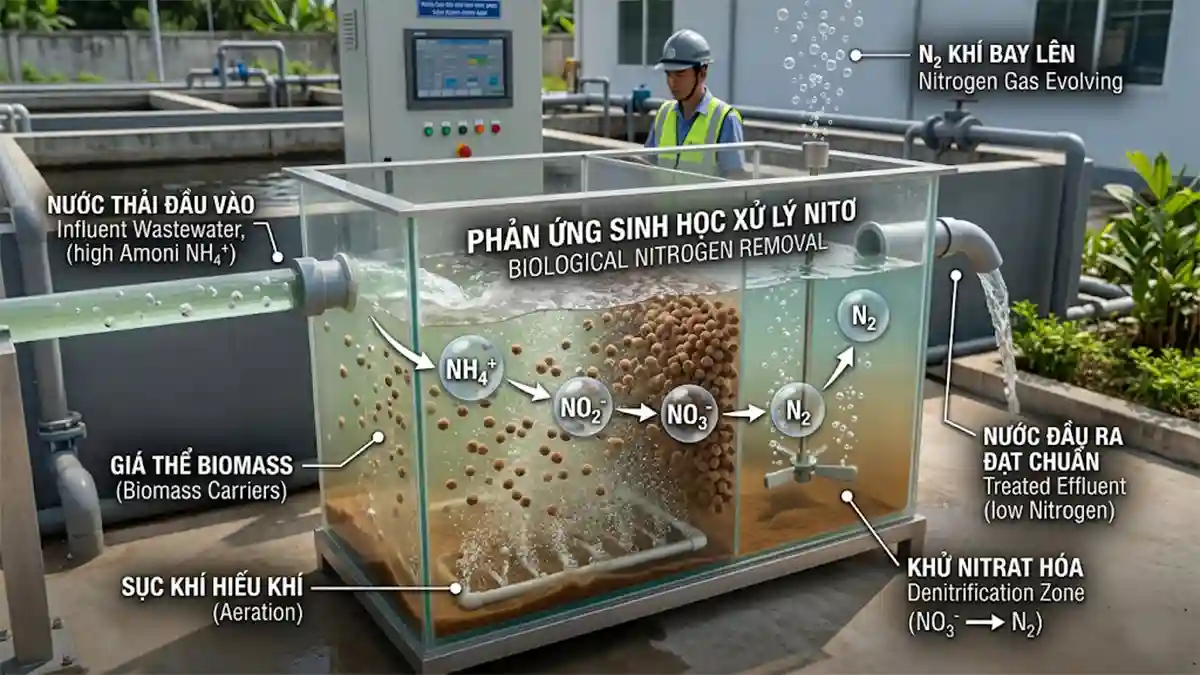
The most optimal and economical solution today is the application of biological processes. This cycle takes place through two continuous stages in specialized tanks:
Nitrification Process in the Aerobic Tank
This is the process of oxidizing Ammonium into Nitrate thanks to groups of autotrophic bacteria, Nitrosomonas and Nitrobacter.
- Required conditions: Dissolved Oxygen (DO) maintained stably from 2.0 – 4.0 mg/L.
- Note: This process consumes a lot of alkalinity and lowers the pH of the water.
Denitrification Process in the Anoxic Tank
After Nitrate is formed, the wastewater needs to be directed to the anoxic tank. Here, heterotrophic bacteria will strip oxygen from Nitrate molecules for respiration and release harmless Nitrogen gas ($N_2$). This is the decisive stage that helps reduce the Total Nitrogen index in nitrogen removal in wastewater.
3. Most Popular Nitrogen Removal Technologies Today
To realize the microbiological mechanism, the following technology schemes are often prioritized:
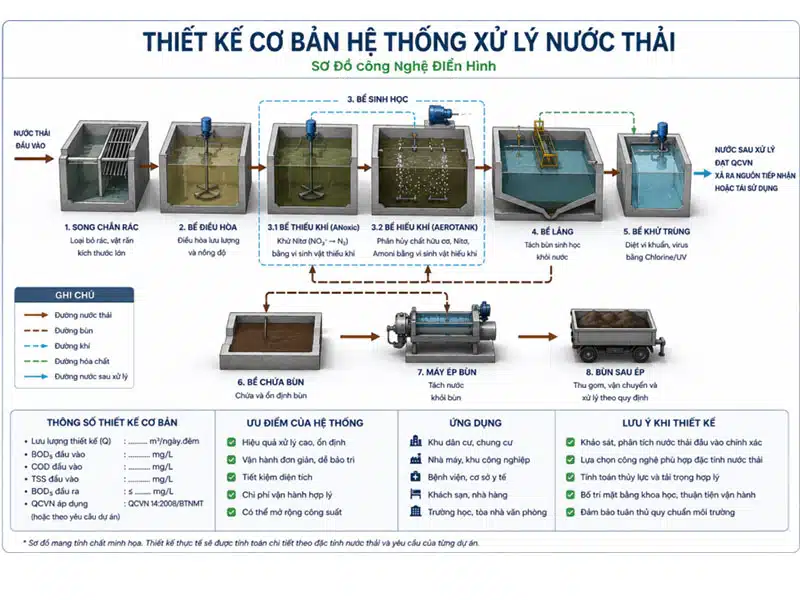
- AO Technology (Anoxic – Oxic): A classic model combining anoxic and aerobic tanks with a Nitrate internal recycle line.
- AAO Technology: Adds an Anaerobic zone to simultaneously treat Phosphorus.
- MBBR (Moving Bed Biofilm Reactor): Uses moving media to increase the density of attached microorganisms, extremely effective for upgrading nitrogen removal in wastewater capacity without expanding the tank area.
- SBR (Sequencing Batch Reactor): Batch treatment integrating stages into a single reactor, flexible for fluctuating water flows.
The Nitrogen Cycle
The Nitrogen Cycle is a vital biogeochemical process where nitrogen is converted between different forms in an ecosystem. Below are the main steps:
- Nitrogen Fixation: Nitrogen-fixing bacteria (such as Rhizobium) convert atmospheric nitrogen (N2) into ammonia (NH3) or organic nitrogen compounds usable by plants.
- Nitrogen Assimilation: Plants absorb ammonium or nitrate to create amino acids and proteins. Consumers then incorporate this nitrogen into the food chain.
- Ammonification: When organisms die, organic nitrogen is converted back into ammonium by decomposing bacteria and fungi.
- Nitrification: Ammonium in the soil is converted into nitrite (NO2-) and then nitrate (NO3) by nitrifying bacteria.
- Denitrification: Denitrifying bacteria convert nitrate back into atmospheric nitrogen gas or nitrogen oxides, completing the cycle.
Biological Method – Two-Stage Process:
- Stage 1: Nitrification (Aerobic)NH4++1.5O2→NO2−+H2O+2H+
NO2−+0.5O2→NO3−
- Stage 2: Denitrification (Anoxic)NO3− \rightarrow NO2- \rightarrow NO \rightarrow N_2O \rightarrow N2\uparrow
4. Why are Nitrogen Levels Still High Despite the System Running?
Many operators encounter high effluent Ammonium despite blowers running continuously. Key causes include:
- Carbon Source Deficiency: Denitrifying bacteria need “food” (Carbon). If the BOD:TN ratio is lower than 4:1, denitrification will stop.
- Insufficient Alkalinity: When pH drops below 6.5, nitrifying bacteria are inhibited and stop converting Ammonium.
- Faulty Nitrate Recycle: If the internal recycle pump from the aerobic tank to the anoxic tank lacks sufficient flow, the Total Nitrogen index cannot be reduced.
5. Solutions for Control and Operating Cost Optimization
To ensure the nitrogen removal in wastewater system operates stably, investing in quality equipment is key:
- Air Blowers & Fine Bubble Diffusion: Ensure uniform dissolved oxygen and avoid “dead zones.”
- Specialized Microorganisms: Supplement high-concentration microbial strains to quickly recover the system after shock loads.
- Monitoring Devices: Use online pH and DO sensors for timely adjustments.
6. Frequently Asked Questions (FAQ)
- What is the ideal C:N ratio for nitrogen removal?The $BOD_5:TN$ ratio should be maintained between 4:1 and 6:1.
- Why does pH decrease during Ammonium treatment?Nitrification releases H+ ions, making the water more acidic. Supplementing alkalinity (Soda or Lime) is necessary to maintain pH at 7.2 – 8.0.
- Does fine, non-settling sludge affect nitrogen removal?Yes. Fine sludge is often a sign of nutrient deficiency or unstable oxygen, leading to a severe drop in nitrogen removal in wastewater efficiency.
Conclusion
Nitrogen removal in wastewater is a sophisticated technical process. By controlling variables like DO, pH, and C:N ratios, and using quality support equipment, businesses can safely maintain discharge standards and optimize costs.
Wastewater treatment solution using plasma technology, see more…