
industrial PFAS wastewater pretreatment has become a 2026 engineering priority because emerging contaminants, climate targets, data assurance, and lifecycle liability now influence treatment decisions. A generic equipment diagram cannot replace a source map, load profile, test plan, and residual pathway.
Quick answer: industrial PFAS wastewater pretreatment works when the facility defines the decision first, measures a defensible baseline, pilots the barrier under real conditions, controls secondary streams, and links every alarm to an owner and response time.
PFAS behavior is governed by chain length, functional group, co-contaminants, organic carbon, salinity, and treatment residuals. Conventional oxidation and biological treatment are not reliable destruction barriers for the strong carbon-fluorine bond. This guide uses EPA water research on PFAS and EPA PFAS treatment and destruction research as primary references. Site permits, applicable standards, receiving conditions, and regulator requirements remain project-specific.

What is industrial PFAS wastewater pretreatment?
industrial PFAS wastewater pretreatment is a source-focused treatment train that isolates high-strength PFAS streams before they enter a biological plant, then concentrates, captures, and manages the contaminant with verified mass balance.
A defensible program connects chemical purchasing records, process recipes, drain maps, flow data, analytical QA/QC, treatability testing, and residual disposal. The purpose is to control the whole PFAS pathway rather than optimize one water sample. The working definition should state the system boundary, unit of measure, time basis, uncertainty, and conditions where the conclusion is not valid.
The topic belongs inside a broader architecture that may include wastewater treatment equipment, MBR membrane treatment, and QCVN 40:2025/BTNMT guidance. This prevents a local optimization from moving the pollutant into sludge, concentrate, spent media, exhaust, or a different operating period.
A strong basis of design separates measured facts from assumptions and lists low, normal, and high loads, abnormal scenarios, redundancy, sampling points, and acceptance tests. Open assumptions should become pilot questions.
Why industrial PFAS wastewater pretreatment matters now
Environmental programs are moving from one-time outlet tests toward lifecycle control. Operators need to know where the pollutant or emission originates, how it moves, where it is retained, and which residual or release ultimately leaves the boundary.
Data quality is part of the treatment train. Sample custody, calibration history, setpoint versions, alarm timestamps, and change records determine whether a result can support compliance, procurement, or capital approval.
| Metric or KPI | Unit or record | Decision supported |
|---|---|---|
| PFAS mass loading | mass/day | Sizes the treatment barrier |
| Total organic carbon | mg/L | Predicts adsorption competition |
| Empty bed contact time | minutes | Controls media performance |
| Breakthrough ratio | C/C0 | Triggers media change |
| Residual PFAS inventory | mass/batch | Closes the mass balance |
Each KPI needs a normal band, warning threshold, action threshold, and rule for stale or missing data. A green dashboard is not evidence when the sensor is fouled, uncalibrated, or installed at an unrepresentative point.

How to implement industrial PFAS wastewater pretreatment
The following sequence moves from a decision question to verified evidence. Every step should name its inputs, deliverable, reviewer, stop criterion, and unresolved risk before procurement advances.
- Step 1: Build a PFAS source and chemical inventory. Preserve raw data, operating context, assumptions, and the remaining uncertainty before moving forward.
- Step 2: Map drains and segregate concentrated batches. Preserve raw data, operating context, assumptions, and the remaining uncertainty before moving forward.
- Step 3: Create a PFAS-safe sampling and blank program. Preserve raw data, operating context, assumptions, and the remaining uncertainty before moving forward.
- Step 4: Characterize target compounds and matrix interference. Preserve raw data, operating context, assumptions, and the remaining uncertainty before moving forward.
- Step 5: Screen GAC, ion exchange and high-pressure membranes. Preserve raw data, operating context, assumptions, and the remaining uncertainty before moving forward.
- Step 6: Pilot under realistic loading until breakthrough. Preserve raw data, operating context, assumptions, and the remaining uncertainty before moving forward.
- Step 7: Define residual destruction, disposal and documentation. Preserve raw data, operating context, assumptions, and the remaining uncertainty before moving forward.
A pilot must capture flow, load, temperature, pH or gas condition, energy, reagent use, equipment state, and residual production. One successful shift at favorable conditions is not a full-year performance guarantee.
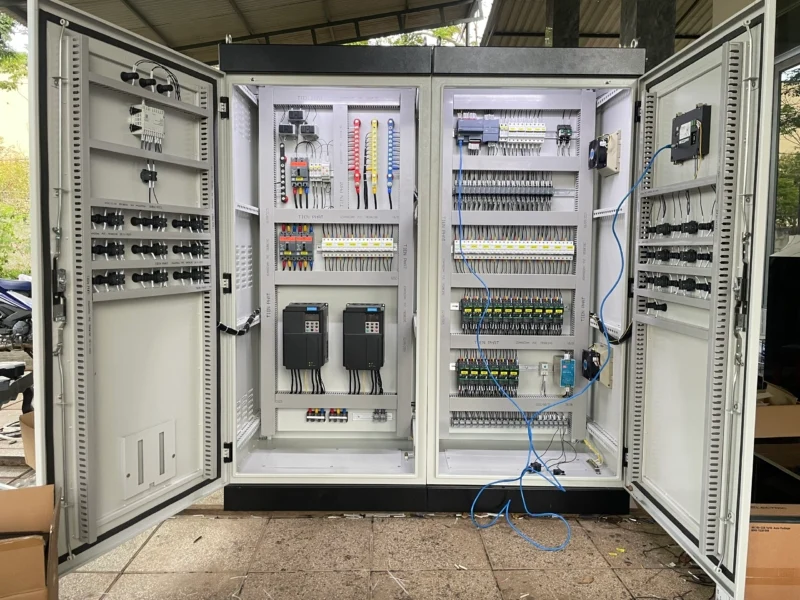
Controls should follow the fail-safe principles used in wastewater control panels: critical interlocks stay local or in the PLC, setpoint access is controlled, and alarms retain old and new values with timestamps.
The handover package should contain as-built drawings, I/O lists, program backups, calibration records, materials, SOPs, cause-and-effect, FAT/SAT evidence, and spares. Review real environmental projects for the effect of layout and access.
Data architecture for industrial PFAS wastewater pretreatment
Concentration should be paired with flow to calculate mass loading. Removal needs synchronized inlet and outlet context. Energy must be normalized by flow, pollutant removed, or production so dilution cannot create a false efficiency gain.
The QA/QC plan should cover blanks, duplicates, standards, recovery, detection limits, chain of custody, and data-rejection criteria. Online instruments need cleaning, calibration, cross-checks, and explicit maintenance flags.
Store data against equipment identifiers, SOP versions, and change owners. That structure allows the preventive maintenance team to diagnose causes instead of reconstructing events after a failure.
For material changes, update the basic engineering package before changing PLC logic or piping. Every manual override and bypass needs authorization, duration, logging, and an alarm.
Common industrial PFAS wastewater pretreatment failure modes
| Observed problem | Likely cause | Priority response |
|---|---|---|
| Rapid media exhaustion | High TOC or short contact time | Add pretreatment and resize beds |
| Short-chain PFAS leakage | Media selectivity mismatch | Test resin or membrane polishing |
| Cross-contaminated samples | Fluoropolymer materials in sampling | Apply blanks and approved materials |
| Unmanaged concentrate | Separation mistaken for destruction | Define an end-of-life route |
The response order is to verify the measurement, protect people and equipment, isolate the source, inspect the process, compare the load, and only then change controls. Simultaneous setpoint changes destroy diagnostic evidence.
Recurring failures require root-cause analysis. A work order should close only after a retest, measurement, or field record confirms the correction, not after a note that says the issue was handled.
When the existing system has no operating margin, develop a load-reduction scenario and request a technical review before increasing production or changing raw materials.
industrial PFAS wastewater pretreatment cost and value
The strongest business case often comes from reducing PFAS-bearing chemistry and segregating small concentrated streams. Lifecycle cost must include media replacement, membrane concentrate, analytical work, transport, downtime, and liability.
The financial model should separate capital, operating cost, analysis, downtime, consumables, secondary residuals, and contingency. A low equipment quote does not compensate for unreliable data or an unmanageable waste stream.
Compare alternatives using total cost of ownership and cost per unit of verified load reduction. The industrial equipment store can support component screening, but final selection must match materials, duty point, corrosion, and redundancy.
After three to six months, compare the new baseline with the original data, explain every material difference, and update the operating envelope. Savings count only when environmental quality, safety, and availability remain protected.
industrial PFAS wastewater pretreatment commissioning checklist
- The objective, boundary, and applicable requirement are documented.
- Source, flow, and mass loading have representative data.
- Sampling or sensors have an explicit QA/QC plan.
- The technology was tested on the real matrix and load range.
- Secondary residuals have a mass balance and destination.
- Alarms, interlocks, local-auto, and power-loss cases were tested.
- The SOP assigns thresholds, actions, owners, and response times.
- Operators received drawings, backups, calibration, and spares.
- Cost, performance, and safety KPIs have a baseline.
- Post-commissioning results are stored with evidence.
Frequently asked questions about industrial PFAS wastewater pretreatment
Does pretreatment destroy PFAS?
Most established pretreatment barriers separate or concentrate PFAS. Destruction requires a validated downstream technology and residual plan.
Which technology is best?
The answer depends on PFAS profile, flow, organics, salts, discharge target, residual route, and pilot breakthrough data.
Why is mass balance important?
A low effluent concentration may simply mean PFAS moved into resin, carbon, concentrate, foam, or sludge.
How often should industrial PFAS wastewater pretreatment be reviewed?
Review after changes in feed, production, rules, equipment, or abnormal results. Monthly trend reviews for critical KPIs can detect drift before a permit or performance limit is missed.
What should a facility prepare before an engineering review?
Provide PFDs or P&IDs, flow, analyses, load schedule, chemical inventory, alarm logs, energy, maintenance history, and the target outcome. Imperfect data remain useful when their source and confidence are stated.
industrial PFAS wastewater pretreatment: final decision
industrial PFAS wastewater pretreatment creates value when an emerging environmental issue becomes a measurable, testable, and traceable decision process. Source control, data quality, piloting, and residual management should be designed as one system.
IES VNTECH supports surveys, design, equipment, automation, commissioning, and operating procedures. Review IES VNTECH capabilities or use the contact page for a project-specific assessment.
Bình luận (0)